Showing posts with label ECONOMY. Show all posts

Friday, 31 May 2013

Anti-corporate tax avoidance measures taking shape

And this is just in the UK
The Organization for Economic Co-operation and Development (OECD) is looking into what action might be taken to curtail corporate tax avoidance schemes, a subject that has been much in the media of late. Leading politicians are responding to outcries coming from commentaries about what little tax is being paid by mega-global businesses on sales of billions, by shuffling profits around the world. This despite protestations from the latter, who say that they are not breaking current law. Among new legislation or measures being studied are tweaking or eliminating double-tax agreements (DTAs) between countries that can allow for neither country taxing a corporation, so-called transfer pricing and improvements to, even>>>the obligation of, exchanging fiscal information among OECD countries, as well as bringing some of the more outrageous off-shore corporate tax facilities to heel.>>>

Friday, 19 April 2013

Spain's share of the cruise ship business tops the European list for growth

Málaga cruise terminal
MALAGA The European Cruise Council (ECC) recently placed Spain at the top of its list of growing host countries. The country shows growth of 18% over the last ten year, ahead of Germany (13%), Italy (12%) and Britain (8%), according to a report by GP Wild for the Council. This growth has made Spain a strategic market for the cruise industry and one that places it fourth at European level with 703,000 passengers in 2011. The evolution of the market means a considerable contribution to the Spanish economy, not exactly at the best of times at present. For instance, it generated well over 25,000, direct, indirect and induced jobs in 2010, growing by 4% over the previous year. (A more detailed article on this subject will soon be available on SpainInformer.com)

Tuesday, 12 March 2013

La Línea police patrol on foot because their only vehicle is broken down

Patrolling on foot
(Photo: europasur.es)
LA LÍNEA Members of the Policía Nacional patrolling the match between Division B clubs Real Balompédica and la Unión Deportiva Melilla yesterday were unable to do so other than on foot. They were also unable to carry their riot gear, also because the only vehicle available to them is broken down and has been for two weeks. Apparently, the central police authorities have yet to approve its repair or substitution, let alone put more vehicles into service. Fortunately there were no incidents to report.

Wednesday, 16 January 2013

'Administrations will no longer be financed by owing their suppliers' says minister

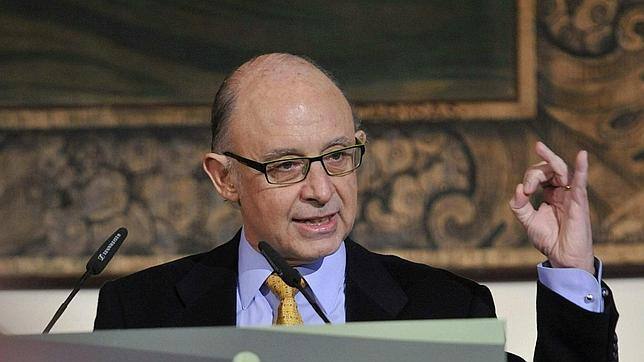
Minister Cristóbal Montoro
(Photo: abc.es)
SEVILLE At a press conference in Seville earlier this month, the Treasury and Public Administrations Minister, Cristóbal Montoro, announced that the tax authorities will soon be provided with new measures whereby suppliers to public administrations such as regional or local authorities, will be able to turn directly to his Ministry for payment. For this purpose, the Treasury will retain money from these administrations when bills become overdue by more than what is established in the law on debts. Until now, the only reason money could be kept back from the Participación en los Ingresos del Estado (PIE, or State Income Participation) system was when taxes or social security payments were owed. (A more detailed article on this subject will soon be available on SpainInformer.com)

Sunday, 25 November 2012

The hard work it takes to get a cork into your bottle


JIMENA Isidoro Herrera, retired foreman of Jimena municipal maintenance workers, has just created this lovely piece on YouTube about the workers in the cork oak hills that are in and around Jimena, including several Campo municipalities that border on them. You will have read that the Council voted unanimously to seek help from the European Commission to investigate what is happening to the trees that are drying up for no apparent reason. If the cork oak disappears it will mean the ruin of many local families, not only of Jimena but of all municipalities that have part of the Los Alcornocales Nature Park within their boundaries. And this is a very good reason to insist on buying ONLY those wines that use real cork, not those nasty plasticky wannabes. (To get the perspective of Isidoro's movie, you might also want to read How did that cork get in your bottle? one of several in-depth articles published first on JimenaPulse several years ago. (Thanks to TioJimeno for putting this up so we could find it.)

Monday, 1 October 2012

Another reason Spain is in the mess it's in: 'la caja única'

(c) 2012 CampoPulse
SPAIN The term literally means 'the only box', but perhaps a less literal translation might be 'the single pot', which would explain yet another reason for this country to be in the mess it is. In very general terms, the term is used to describe what happens with taxpayers' money. The government, at whatever level, gets or gives itself a grant or subsidy for a particular project, based usually though not always on an estimate for that job. The money gets put into the caja única, or into the general pot. Accounting methods are rarely clear to the outsider, not least because there is no law in Spain similar to that of the Freedom of Information laws in other countries (there were murmurings about it at the beginning of the year, but nothing since). If there were, it is likely that financing public works would be a great deal less obscure - and the lining of pockets YOU WILL SOON BE UNABLE TO READ THE REST OF ITEMS LIKE THIS WITHOUT A SUBSCRIPTION>>>

Proposals and measures aimed at deficit reduction and growth development for the next two financial years

De Guindos (Economy), de Santa María
(V-P),  Montoro (Treasury)
Opposition and others say this is not the right way to go
MADRID A special meeting of the Cabinet on Thursday came out with several measures dealing with taxation and the economy in general. Among the salient points is the creation of an Independent Fiscal Authority who will control the budgets of all government agencies and ensure that they meet their anti-deficit targets. Another is that real retirement age will be made 'closer to the normal age'; in other words, early retirement paid for by the taxpayer will be phased out, and pensions will become closer to normal life expectancy factors, in such a way as to make the system sustainable. Here are some of the more important decisions approved in Cabinet on Thursday, only a few of the 48 that were finalised. BY THE BEGINNING OF THE YEAR YOU WILL NO LONGER BE ABLE TO READ ITEMS SUCH AS THIS UNLESS YOU SUBSCRIBE. Subscription information will be available soon.>>>

Thursday, 27 September 2012

'Spain scare roils Europe markets': new media 'attack' on Spain

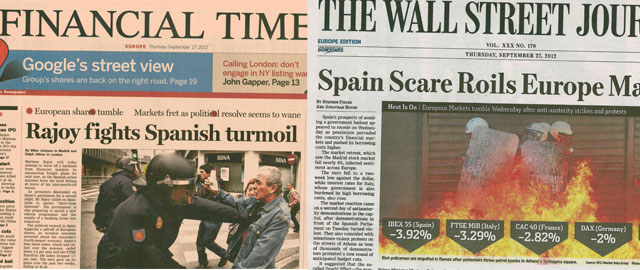
MADRID Just as the emergency budget for 2013 is getting approved in parliament, both the Wall Street Journal and the Financial Times headline the recent demos, still going on last night and a good part of today. The budget is expected to be one of the most austere ever, with swingeing cutbacks and reductions and pay freezes. Among other things Prime Minister Mariano Rajoy is blamed for his government's indecision in asking for a bailout. The BBC's Today programme this morning also dealt with the subject, as do many British and other European newspapers. In the meantime, some of the Spanish media are wallowing in 'poor mes'. Watch this space for a view on the new budget and other economic news.

Monday, 17 September 2012

Crisis in Spain highlights an increasing ‘employment divide’, says ILO

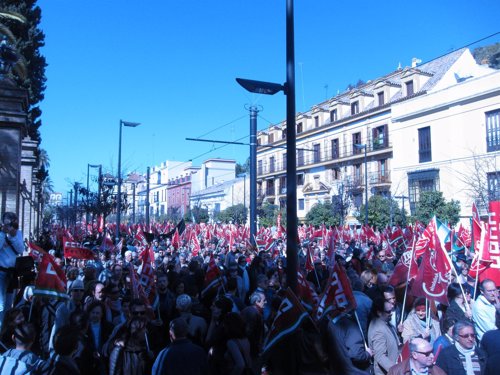
Demo in Seville, Saturday
(Photo: europapress.es)
The wave of social unrest that has recently hit Spain is a reflection of the growing rural/urban and north/south divide in the country.
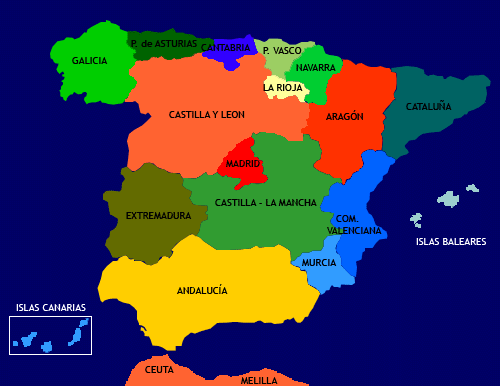
GENEVA (ILO News) – Unemployment in Spain is rising faster in rural areas than in urban centres and is fuelling social unrest, according to the latest statistics produced by International Labour Organization’s International Institute for Labour Studies (IILS).  Unemployment in rural areas jumped from little over 8 per cent in 2007 to more than 26 per cent in 2012, while in urban areas it increased slightly less, from 7.8 per cent to 24 per cent over the same period. The national average is just under 25 per cent.  “The situation is particularly hard in the southern region of Andalucía, which already had high unemployment rates before the crisis. For example, in the provinces of Almería, Jaén and Granada, more than one-third of workers are unemployed,” said Steven Tobin, senior economist at the IILS.>>>

Thursday, 13 September 2012

Portugal to increase employees' tax and lower employers', is Spain next?

Employees' Social Security up from 11% to 18%, and employers' down from 23.75 to 18% · Are there similar plans for Spain?
PORTUGAL (Agencies) Conservative Prime Minister Pedro Passos Coelho announced last week that Social Security payments are going up for employees while coming down for employers. This comes about because, he said, the decisions made by the European Central Bank recently 'are not enough' to guarantee the possibility of cleaning up the country's economy. At the same time, Passos announced several more cutback measures aimed at the same targets as those demanded in Portugal's rescue package of a year ago.In the meantime, the rest of the financial world is waiting for a decision on whether Spain will ask for a rescue, an announcement that in many opinions, will be delayed until after regional elections in the Basque Country and Galicia, scheduled for October 21.

Wednesday, 5 September 2012

Unions warn of new 'mobilisations'

Fernández Toxo, l., and Cándido Méndez
'Spectacular failure of cutbacks policy'
MADRID The leaders of the two main unions, Comisiones Obreras (Ignacio Fernádez Toxo) and Unión General de Trabajadores (Cándido Méndez) warned at a press conference yesterday that they were calling new 'mobilisations' throughout the country because of the failure of the government's economic policy. There was no specific date given but it is idely expected that the demonstrations would probably begin on or about September 15.

Tuesday, 4 September 2012

Large business salaries and profits to be scrutinised

©JimenaPulse 2012
Minister says those who have more should set example
MADRID (Agencies) In a radio interview on Onda Cero, the Minister for the Economy and Competition, Luis de Guindos, asked that all vigilance should be aimed at the salaries, profit margins and pensions of the larger companies. "We are asking for an effort from the average Spaniardand especially from those who are in more privileged positions," he said, "It is they who must give an example." Solidarity, he added, is "fundamental" and begins with those who "have more.">>>YOU WILL SOON BE UNABLE TO READ THE REST OF ITEMS SUCH AS THIS UNLESS YOU SUBSCRIBE. Subscriptioninformation will soon be available.>>>

Tuesday, 21 August 2012

Financial Times says Spanish government will use the crisis to cut back regional authorities

Regions are in deep debt thanks mainly to costs of health, education and social services
MADRID In an article last Thursday, the Financial Times said that the government of Mariano Rajoy wants to take advantage of the financial crisis as a "pragmatic decision" and for "political coverage" to make the national autonomous regions system, which in the FT's opinion the governing PP "detests ideologically." The online edition of the prestigious newspaper says that Rajoy is determined not only to>>>

Tuesday, 17 July 2012

Unemployed to lose benefits with mere 'suspicion' of fraud

Fátima Báñez, Minister of Labour
SPAIN (El PaísThe government’s cutbacks in unemployment benefit payments have taken an Orwellian turn with the announcement that even a suspicion of fraud will be sufficient to suspend payments. As part of its latest austerity drive the Popular party government last week cut the payment of unemployment benefit from 60 to 50 percent of the salary earned previously after a person has been out of work for six months. Until now, a person suspected of defrauding the system - by working while claiming benefits - would lose the right to claim only if and when fraud was definitively proven. In some cases the loss of benefits is temporary; sometimes it is permanent. Under the new regulations, these sanctions can be imposed whether actual proof of wrongdoing is obtained or not. The Labor Ministry justified the decision by saying that this would increase its armory in the fight against fraud. But the labor unions decried the announcement as opening the door to “arbitrariness and the criminalization of the unemployed worker.”

Thursday, 12 July 2012

"It's the only thing we can do," says Government

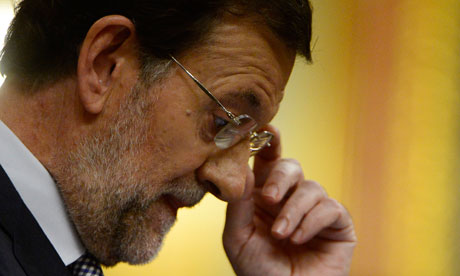
Mariano Rajoy
MADRID Those are the words Mariano Rajoy, President of the Spanish Government, repeated several times in is speech on the new measures he is taking against the "very delicate situation" (his words) the country is in. Below we offer a listing of some of the measures, cutbacks and tax reforms he is proposing, but perhaps the main one is a raise of three percentage points in VAT, which goes up from 18% to 21% in the general rate and two points for the reduced rate (which includes tourism related items but not food, which remains the same at 4%) from 8% to 10% and will cost the 'average' (have you ever met one?) €450 per year extra. The plan he announced yesterday morning in a two hour speech to a plenary session of the Chamber of Deputies and is expected to be largely  approved by the Council of Ministers on Friday, is one of the hardest ever applied in this country. The plan is designed to raise income and lower costs, which, together with past and future measures, to represent a total of €65 billion, or 6.5% of GDP, in the space of two and a half years. These new measures, the fourth such package in as many years but more severe thahn any before, were announced at the same time as miners from Asturias, many of whom walked to Madrid over more than 400 kilometers, were protesting loudly outside. The measures include:>>>

Wednesday, 11 July 2012

Government to announce €30billion in further cutbacks this morning

Mariano Rajoy
Large increase in VAT is expected
SPAIN (Agencies) Mariano Rajoy, President of the Government, is about to present the country with a new round of cutbacks and tax measures, according to the Spanish media. The objective is to meet the demands from Brussels about lowering the national deficit, the result of the EuroGroup meeting held earlier this week, which did relax these demandsomewhat. It is widely believed that the measures will be 'brutal', as one online paper put it. However, some say it will not be as high as the €30 billion - about 3% of GDP - that others expect, aimed at pacifying Brussels for the latest bank rescue pckage. The same sources think that IVA (VAT) will go up significantly, some say up to 23% from the present 18%. One of the many reasons behind the new round of cost cutting (mainly but not exclusively in education, it is thought) is that the country's deficit last year was 8.9% of GDP instead of the 6% once predicted. Some other expected cutbacks: Reducing cost of public servants by asking them to cut out one annual 'extra' salary; freeze pensions; reducing  unemployment benefits; closing down public television stations, more likely the regional ones. The internal debate in its various factions has become well known but the Government is saying officially that nothing has been defined and these are 'merely technical calculations'. We shall see.

Thursday, 14 June 2012

A step away from junk bonds

© 2012 Alberto Bullrich
SPAIN No need to repeat all the details here; you've seen it on the news: Spain's interest rates and bonds were demoted to Baa3 class from its A3 qualification. Ministers can't get to a microphone fast enough to ask for tranquilidad, to say that it is all the fault doubts on Greece and its elections this weekend, that the rescue (no, they don't use the word but the national and international media do) won't cost the citizenry a single euro - always supposing they still exist - and so on and on. CampoPulse or its writers (okay, the single writer, Prospero) have no qualifications in any kind of financing or economy (ask his bank manager), but we/he did write a couple of items on the subject well before they were taken up by everyone else (someone's gotta pat our/my back): Who Owns the Ratings Agencies? and This Is Why Spain is in Such a Mess - if you haven't read them, maybe this is the time...

Wednesday, 13 June 2012

Tons of mussels coming out of the water at Getares

Photo: europasur.es
ALGECIRAS (Source: Europa Sur) The waters just beyond the beach at Getares contain some 15 skiffs that are used for collecting mussels from the sea bed. Mejillones de Andalucía, the company that owns and runs them, announced recently that it would be selling the mussels in tins all over Europe. The president of the company, Juan Antonio Gallardo, said that canning trials had been very satisfactory and his company is hoping for a bumper crop this year of 600 tons, which is excellent compared to the 400 of last year. Canning is to take place in Galicia, as there is no facility with the right capacity any nearer. (Once upon a time, there were several sardine canning factories in Algeciras).>>>

Wednesday, 6 June 2012

This is why Spain is in such a mess

SPAIN If you click on this link, you will see 25 photos of buildings, urbanizations and developments abandoned to the wind and sun after their developers either disappeared or went bankrupt or whatever. These pictures were taken in the province of Málaga only. There are some 14,000 new homes all over Spain (10,000 in Málaga alone) that have remained unsold, and are likely to remain so for some time. One of the main reasons Spain is in huge financial trouble, aside from a hemorrhage of over-spending for the last fifteen years or so, is that these empty buildings have not been paid for. Like the 'sub-prime' scandal in the US, where it all started, the banks lent money without the certainty of getting paid back. Sure, lending money is risky>>>

Tuesday, 29 May 2012

VAT increase 'is not planned' for next year

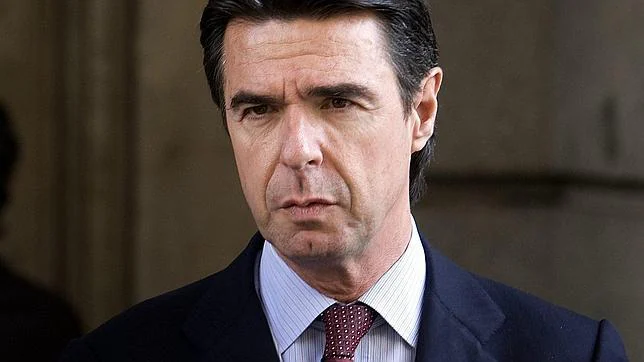
José Manuel Soria (ABC)
SPAIN The Minister for Industry, Energy and Tourism, José Manuel Soria, announced last week, at a luncheon by KPMG and Europa Press, that the Government 'is not planning' an increase in the rate of VAT (IVA in Spanish) for next year. Nevertheless, he added, should such an increase occur, its impact on the Spanish economy, particularly in the tourism industry, would have to be studied very carefully. However, he insisted that an increase was not on the table. On the subject of taxes, Soria admitted that the Government had promised to reduce them for the tourism industry, but the present climate does not allow for any such thing "for the time being." He did say, though, that electricity charges would have to go up "at some time" to put an end to the deficit in the electricity system.