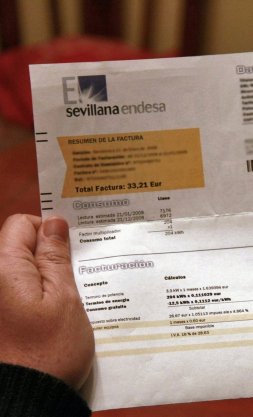
There isn't one, much. The dictionary defines them as follows: factura = bill, invoice; recibo = bill, account (eg recibo de la luz = electricity bill). In fact, the word recibo means receipt, so it could be said that you would get one when the bill has been paid. But no, because this all comes from a bureaucratic past (and present) when there was no direct debit. It was simple: you got a factura, you paid it (at the bank, town hall or wherever, in cash) and you got a recibo. Would that it had stayed as simple... In any case, all either seem to do these days is rise and rise.
Showing posts with label SPANISH. Show all posts
Tuesday, 3 January 2012
Wednesday, 16 November 2011
Wot's a Zarzuela?
SAN ROQUE We often get asked what a Zarzuela is. Our usual answer is 'a Spanish operetta', which is as close as we can come. But for those who have asked, this is a great opportunity to find out exactly: This coming Friday, November 18, at 9pm, at the Juan Luis Galiardo Theatre in San Roque, the Circuito Andaluz de Música is presenting Antología de la Zarzuela, which uses several well-known zarzuelas in its repertoire. At only €5 a ticket, this is a unique chance to get to know a form of Spanish music that is almost unknown to an English-speaking audience.
Friday, 11 November 2011
British Council and Instituto Cervantes, word for word
SPAIN / BRITAIN (El País / Jesús Ruiz Mantilla) The two predominating Western languages in the world had, until recently, looked askance at one another. Now, the challenges of survival and of holding on to their influence in the future are forcing them to align. Palabra por palabra/Word for Word, a new book drafted jointly by the British Council and the Cervantes Institute, constitutes a bilingual compendium of the challenges facing two languages concerned with the unbridled expansion of Chinese, Arabic and Hindi. The longstanding division of the West into an Anglo-Saxon north and a Latin - predominantly Hispanic - south is slowly becoming a thing of history. Combined, both worlds represent nearly a billion people who speak either English or Spanish.>>>
Labels:
ARABIC,
BOOKS,
BRITISH COUNCIL,
CHINESE,
ENGLISH,
HINDI,
INSTITUTO CERVANTES,
LANGUAGE,
SPANISH
Monday, 27 June 2011
Spanish conversation classes in Jimena
SPANISH CONVERSATION There is room for two more groups of three each in Jimena. If you'd like to practice your Spanish using the words and sentences you need every day (and sometimes more), contact Alberto (956 648 169 or 685 298 820). Adults only, several levels (scale yourself from 1 to 10 when you call), at varying times and days. Or you can ask for one-on-one practice. It's up to you if you don't want to feel left out. (It's also a great way to learn about where you've chosen to live...)
Friday, 26 November 2010
Pronouncing Spanish - start at the beginning (Z)
This letter is not the beginning but the end of this series. If you've been following it, you might just remember that we were rudely interrupted by impecunity on Thursday 11th with the letter O, which was the last you will have seen. However, we have now caught up with ourselves and the rest of the letters are now appearing daily where they were supposed to, so go back to O to refresh your memory. As for Z, the dictionary calls it a fricative, interdental, voiceless consonant in Spain, but that's the complicated way of saying that it's pronounced like the English TH, as in 'the'. In some parts of Andalucia and most of South America, it is pronounced like an S. Prospero, who was brought up in South America, finds it easier when in Spain to use the S sound, or he has to 'see' the word in his mind to know how to pronounce it. We are unaware of their being any ZCoches in Spain, and the series was unlikely to have been shown in Franco's time.
Thursday, 25 November 2010
Pronouncing Spanish - start at the beginning (Y)
Why, indeed. (That's por qué in Spanish.) The letter Y, though, has just recently, a couple of weeks ago, undergone some changes: it used to be called I griega (Greek I, as opposed to the Latin I, or I latina) but it's new official name is now ye (pronounced as in ye-s). This will not be apparent when you click the image, so just bear it in mind. On its own, as a conjunction, y means 'and', so tu y yo is 'you and I'. ¿Pero por qué? Porque sí. But why? Because. (Note: please do not ask for frentes I griega, when shopping for underclothes, men. You're not going to look like the picture anyway and we can't remember what the right words for y-fronts are but are glad of self-service at Primark.)
Wednesday, 24 November 2010
Pronouncing Spanish - start at the beginning (W)
In English this is a double-U. In Spanish this is a double-VV (see?). If a V is an uve, then an uve doble, is a double-u. Right? Kind of. Just click on the image and see what we mean (but you'll have to look up the illustrative word in tyour dictionary: we haven't a clue). This letter is not 'native' to Spanish and was adopted relatively recently because of foreign influences. Therefore, in words that are of Germanic origin (e.g. Wagner, wagneriano) it is pronounced as a V. In words of English origin such as vagón (wagon), vals (waltz) and vatio (watt), it has also become a V. One exception is the word for whiskey (of decidedly Scottish origin), which is officially spelt güisqui, but you needn't worry about it as the original will be understood perfectly. We'll leave the two dots over the U, called a diéresis in Spanish, until later (phew!).
Pronouncing Spanish - start at the beginning (X)
The X factor in Spanish is similar to the English. It sounds the same in both languages, although in Spanish it was the original for J. So Xeres became Jerez (and then 'sherry' in English, which does not denote a place as well as a drink as in Spanish) and Don Quixote (or Don Quixot in English) became Don Quijote. Back then it sounded like the English sh or the French ch, but this no longer common. The X factor is not very common in Spanish either.
Monday, 22 November 2010
Pronouncing Spanish - start at the beginning
To V or not to V, that is the question. There is a problem here, let's face it. A very large proportion of the enormous Spanish-speaking population has trouble spelling words containing this letter or a B. That's because they are pronounced very similarly. In the (g)olden days of education, when Prospero was at infants' school, he was taught that there is a clear distinction between the two. However, the guardians of the language at the Real Academia have been debating the subject for decades and we wouldn't want to get in their way, so just listen and learn and get over it. (We admit to being tempted to write about the V-sign and what it means in both languages but - oh, what the heck, see below)>
Friday, 19 November 2010
Pronouncing Spanish - start at the beginning (U)
Ooooh, now this one's the last of the vowels, and what did we say about them? That there is only one way to pronounce them in Spanish - it doesn't depend on what's in front or behind, like in French or Portuguese. This one is pronounced as you will hear when you click on the image - except (there's an exception to every rule) when it follows a Q or a G. So queso (cheese) is pronounced keso - see, no u? Oooh, innit easy?
Thursday, 18 November 2010
Pronouncing Spanish - start at the beginning (T)
Tea for dos, and two for tí. No probs, as they say Down Under. It's the same sound as in English and most other languages. But the letter is called te (as you'll hear if you click on the image, and of course, you remember about the only way to pronounce the vowels a, e, i, o and u, don't you?). What's the word for tea in Spanish? Té. Now you're confused, arent you? Here's more: it's a voiceless alveolar plosive. Taw was the last letter of the Western Semitic and Hebrew alphabets, and probably represented a cross. The sound value of Semitic Taw, Greek alphabet Tαυ (Tau), Old Italic and Latin T has remained fairly constant, representing [t] in each of these; and it has also kept its original basic shape in all of these alphabets, according to that wonderful tool Wikipedia. And now for a nice taza de té.
Wednesday, 17 November 2010
Pronouncing Spanish - start from the beginning (S)
This is, of course, a very ssssinister letter. Ssssnakes ssssay it and look what happened to Eve after she listened to it. (What language did they ssspeak in Paradissse?) But you may not have the same problem in Spanish since it sounds exactly like in English. Sssso just click on the image and hear it, and learn a new word while you're at it. Here are a few more: sonido (sound), siniestro (sinister), soledad (solitude), Señora/señora (Mrs./lady and we'll bet you've forgotten about the ñ, check back here).
Tuesday, 16 November 2010
Pronouncing Spanish - start from the beginning (R)
Now here's one especially designed for the Scots, who can rrrrroll their RRRRRs. The rest of you will have to do the best you can. In case you wondered, this letter is an alveolar trill in Spanish and an alveolar approximant in English. If you click on the links on these two descriptions, you will be able to tell the difference. Clicking on the image will do what we have been doing since this series on pronunciation began. And when you've learned to put your tongue just between the palate and the teeth, and it stops tickling, we'll ask you to say, Qué rápido ruedan las ruedas del ferrocarril. And now we've complicated it for you. Look at the phrase again and notice that some of the Rs are single, and some are double. The double ones are pronounced more strongly ( than their single neighbours - but we wouldn't worry too much, particularly if you're not Scottish.
Monday, 15 November 2010
Pronouncing Spanish - start at the beginning (Q)
This one's not terribly tricky. It's pronounced like a K. The only trouble arises when it is used with a -ue (as in queso, cheese) or -ui (quizás, perhaps, maybe) because you do not pronounce the U. But that has more to do with the U than the Q. In any case, we can't think of any other way it is used other than with the -ue or -ui, so that makes it even easier. Have a try, click the letter...
Friday, 12 November 2010
Pronouncing Spanish - start from the beginning (P)
(Note to followers of this series: Watch your Ps and Qs, they're all appearing when they were supposed to but we were so rudely interrupted by impecunity at the letter O, so you might want to go back there...) This letter, however, is not pronounced any differently to its English equivalent. But for amusement's sake, here's a related thing: Penélope Cruz's nickname is Pe, just as the letter sounds. Why isn't it Pene, which sounds more like the English diminutive Penny? Look up the word in your dictionary, we're too embarrassed...
Thursday, 11 November 2010
Pronouncing Spanish - start at the beginning (O)
Oh, now this one's really easy, isn't it? If you remember, there is only one way to pronounce the vowels in Spanish (with very few exceptions we'll look at later), so the o in Spanish is not pronounced as in the English alphabet! It is not 'oh' but 'o' as in 'not', shorter, sharper. Easy. A few words: ombligo ('navel' - useful word, and subject to observation), olor ('smell', but not aroma, which has the same meaning); opción ('option'): onomatopéyico (just kidding... means onomatopoeic, or a word that imitates a sound, like 'bang' for instance.)
Wednesday, 10 November 2010
Pronouncing Spanish - start at the beginning (Ñ)
Now this one does not exist in any other European language and has no equivalent in English, which is why the EU and the USA (via Microsoft) tried hard to surpress it and remove it from our keyboard - luckily, they didn't. When you click on the pic, you'll hear a familiar sound. It sounds like the 'gn' in French (Avignon) or the 'nh' in Portuguese but you'll have heard the word niño or niña for 'boy' and 'girl', right? It's difficult to write the pronunciation out, but try 'ni' for the ñ in niño - should sound like 'ninio'. There, you've got it! In case you wondered, it's a consonantic phoneme with nasal and palatal articulation - well, that's what the dictionary says, look: fonema consonántico de articulación nasal y palatal.
Tuesday, 9 November 2010
Pronouncing Spanish - start at the beginning (N)
No difficulty with this one, either. Same pronunciation as in English, no tricks to trip you up. A few words to practice: ninguno ('none'); nadie (no-one/nobody); nada ('nothing' / 'not at all' in the colloquial); Nilo ('Nile' river); nalgas ('buttocks', never know when you'll need this word); nadar ('to swim'); nueve (click on the picture and hear it said). Please note that many of these, and other words, are accented on the second-before-last syllable, which is an approximate rule of thumb, so long as there is no written accent like this ´ over a letter. If it's there, the stress is on that letter.
Monday, 8 November 2010
Go back - start at the beginning!
Pronouncing Spanish - start at the beginning (M)
Mmmm. Not difficult this one. Has the exact same pronunciation as in English so we won't make a fuss of it. A few words to practice on: mio/mia (mine, depending on gender); mano (hand, and an exception to the a/o rule on gender - but don't be confused by us, we'll get to that later); material (same meaning as in English); magnífico (you guessed it); minuciosidad ('thoroughness' but we're just kidding). Please note that each word here, and elsewhere in this series, has a bold letter in it. This is so you can see where the stress on the word is. Sometimes there's a written accent, but we'll get onto that later, too...
Subscribe to:
Posts (Atom)


