Showing posts with label UNEMPLOYMENT. Show all posts

Wednesday, 15 May 2013

Food Bank beats it's own record in April

ALGECIRAS The Campo de Gibraltar Food Bank operates out of a large space in the town, ceded for free by its owner. Headed by José Cabello, it recently announced that it had beaten its own record thanks, he says, 'to the solidarity of the people and businesses of the area.' Over 90,000 kilos of foodstuffs were distributed in April, almost double the approximate 50,000 that is the norm. Much of it is the result of Operación Kilo run by the Carrefour chain's branches in La Línea and Los Barrios, which encouraged customers to donate a kilo of non-perishable goods. The company collected some 25,000 kilos, and then doubled that amount in donations. The Food Bank thanked the Fundación Solidaridad Carrefour, also for the donation of a large electric fork lift, which will make the work at the distribution centre much easier. Cabello pointed out that this kind of thing encourages the volunteers on which the Bank depends.

Tuesday, 7 May 2013

Brain Drain is 'External Mobility', says Minister

(Image: www.noticiassin.com)
MADRID In a typically political euphemism, Employment Minister Fátima Báñez recently referred to the 'external mobility' of young employables who are leaving Spain in relative droves for jobs in other parts of Europe. This used to be called 'brain drain'. Whatever the name, Báñez has admitted that a good many people, mainly university graduates, have left this country to seek better employment opportunities for work or study elsewhere - not surprising with unemployment among the critical 18 to 25 group at over 57%. According to the minister, there is some balance to the figures: in 2012 17,300 young people left Spain, but there were a lot of foreigners coming into the country. She pointed out that there are 30,000  Germans, 40,000 from the UK and 60,000 Italians here. "What we want,">>>

Monday, 1 April 2013

Two of every ten over-55s will lose unemployment benefits when changes come into effect

The government has decreed that total household not individual income is to be applied in assessment
MADRID Employment Minister Fátima Báñez admitted last week that 80% of over-55s in Spain will have no problem with receiving unemployment benefits when the new income requirements come into effect later this year. It is the other 20% that is worrying much of the media, not to mention unions and other social agencies. These potential beneficiaries are likely to remain beyond the requirements of the new norms as these come into effect. Regulations stipulate that household income must be taken into account as a whole, rather than those of the individual. (A more detailed article on this subject will soon be available at SpainInformer.com)

Thursday, 14 March 2013

Iberia and unions reach agreement: strike off

Iberia on the ground
(Photo: planespotters.net)
MADRID Iberia, the airline that belongs to IAG (International Airlines Group) together with British Airways, has reached an agreement with the main unions, who have called of the strike that had been scheduled for Easter, one of the year's busiest times. The proposal to call off the strike came from the mediator in the otherwise bitter negotiations, Gregorio Tudela. So far, the number of redundancies proposed by IAG has been reduced from 3,807 to 3,141. The unions entered the negotiations last year in the belief that Iberia was about to be 'dismantled' by BA, which, in the medium term would not be entirely surprising for an airline that loses close to a million euros a day.

Tuesday, 12 March 2013

NH announces staff reductions at 38 hotels in Spain

Almenara Hotel, Sotogrande
MADRID / SOTOGRANDE The NH Hotels group yesterday presented its unions with EREs (Expediente de Regulación de Empleo, or 'provisional downsizing plans') that will impact 38 of its hotels in this country. The group owns Sotogrande S.A., as well as two major hotels inside that resort, the Almenara and the NH Sotogrande, plus the NH Algeciras Suites and the NH Campo de Gibraltar, and several on the Costa del Sol. There is no news as yet on which hotels will be affected, but negotiations with the unions are due to start on the 15th. The period for legal matters to be solved is thirty days, which means that redundancies may start around mid-April.>>>

Wednesday, 23 January 2013

Spanish Embassy in London opens employment website

LONDON The Spanish Embassy in London recently opened a website with information for Spanish people now living in the UK, but also for those in Spain who might want to move to there to find employment. It lists companies seeking employees, as well as useful advice on interviewing, and several how-tos: banking procedures, registering for social security, rental procedures, etc. The UK has become one of the preferred destinations for a new generation of Spanish emigrants with plenty of qualifications -many are university students- in the 25 to 35 age bracket. The Spanish Consulate in London says there are some 71,000 Spanish citizens living in Britain, a significant increase owing to the crisis. Ambassador Federico Trillo says that if the experiment is successful, it may be applied at other embassies through the world. He and other embassy staff are quick to point out that the website is not aimed at encouraging emigration; the labour market there is 'highly competitive' but there is 'only' a 7.8% unemployment rate, compared to Spain's 26%.

Wednesday, 24 October 2012

What, me worry? Yes, says government polling company

MADRID According to the latest report from the CIS (Centro de Investigaciones Sociológicas) in their September 'barometer' reading, the three things that worry Spaniards the most are, in the following order: unemployment, the financial crisis, and politicians. The survey also shows that confidence in and regard for the governing PP party is declining swiftly since the elections of November 20 last year, whereas the PSOE is gaining very few points. Concern about the crisis and the resulting cutbacks is understandable, but that politicians and politics in general is a deep worry among the citizenry is what one pundit calls a 'catastrophe for democracy'.COMING SOON: SUBSCRIPTION INFORMATION>>>

Monday, 17 September 2012

Crisis in Spain highlights an increasing ‘employment divide’, says ILO

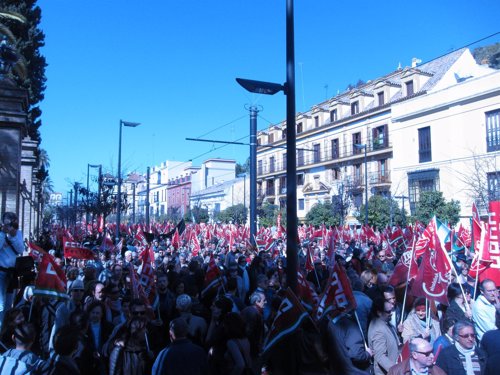
Demo in Seville, Saturday
(Photo: europapress.es)
The wave of social unrest that has recently hit Spain is a reflection of the growing rural/urban and north/south divide in the country.
GENEVA (ILO News) – Unemployment in Spain is rising faster in rural areas than in urban centres and is fuelling social unrest, according to the latest statistics produced by International Labour Organization’s International Institute for Labour Studies (IILS).  Unemployment in rural areas jumped from little over 8 per cent in 2007 to more than 26 per cent in 2012, while in urban areas it increased slightly less, from 7.8 per cent to 24 per cent over the same period. The national average is just under 25 per cent.  “The situation is particularly hard in the southern region of Andalucía, which already had high unemployment rates before the crisis. For example, in the provinces of Almería, Jaén and Granada, more than one-third of workers are unemployed,” said Steven Tobin, senior economist at the IILS.>>>

Wednesday, 12 September 2012

Unemployed to help with clean-up after fires

MADRID (Agencies) The unemployed in Spain will be drafted to clean up the remains of brush and forest fires that have destroyed some 180,000 hectares of land throughout the country. If they refuse, they are likely to lose at least three months of their unemployment benefits. The emergency measure was approved by the Cabinet and announced by Deputy Prime Minister Soraya Sáenz de Santamaría, who also said that it applied only to those on the Plan Prepara programme, a government subsidy for the long term jobless whose benefits have run out.

Tuesday, 11 September 2012

Fund raiser for very needy unemployed families

Click to enlarge
JIMENA The youth organization, Mirador Joven, and the association for the unemployed of Jimena, Plataforma de Parados, have come together to raise funds for the 120 families that have absolutely no income because all members are unemployed and their benefits have run out. This is about 1,200 people out of a 'working' population of some 4,000 - an enormous proportion! Tickets are only €4, plus as much non-perishable food as you can bring (basics like rice, chick peas, lentils, oil, spaghetti, etc. etc. are welcome, a little luxury like sliced jamón, or some chorizos, or whatever, would be nice, too. Sweeties might be an idea as well). Ticket sales, probably all over the village, started today. There will be all sorts of activities for kids of all ages. The date: Sunday, September 23. The place: down at the sports pavilion. The time: from 11 am to 7pm. For more info call 637 013 502. This is important, folks, they need our help. 

Thursday, 23 August 2012

New help for the unemployed

Benefit rises to €450 - with stricter rules
SPAIN The government of Mariano Rajoy had been under pressure for some time to keep the €400 benefit for the unemployed, which was due to run out at the end of this month. So the Minister for Unemployment and Social Security, Fátima Báñez announced yesterday that a new such benefit, called Prepara, would come into effect immediately. This would extend the previous benefit, but would be for €450 instead. However, the three objectives set out in a press release (improve protection for those who really need it, reinforce the requirements for those who benefit so that it is easier for them to access employment, and increase cooperation with regional authorities to improve the plan's efficiency) are widely believed to be leading to much more stringent regulations as to who receives the benefit. Thus, as a whole, the benefit will be given to those who have no income at all, above 75% of the minimum monthly wage - €641.40 in 2012. Those who have previously received the benefit may also apply if their circumstances have not changed.

Sunday, 29 July 2012

Citypeg warns of Spanish worker redundancies in Gibraltar public sector

Monument to Spanish workers
La Línea
Unite union accused of 'looking the other way'
LA LÍNEA (Agencies) One of the organizations that covers Spanish workers in Gibraltar, Círculo de Trabajadores y Pensionistas Españoles en Gibraltar (Citypeg), sent out a warning last week that the Rock's Labour Minister, former Chief Minister Joe Bossano, is aiming to fire Spanish workers now employed by the public works department. According to Citypeg, Bossano is intent on "changing a full-time, indefinite employment contract for one that lasts only 11 months, and which when it comes to an end, will not be renewed, thus leaving these Spaniards unemployed." The organization called this idea "discriminatory" and accused Unite, the local union, of "looking the other way." "We are not surprised by Unite's attitude while thgis is going on," said a spokesperson, who went on to add that the new Governemnt of Gibraltar is creating "an unsustainable situation that could unleash confrontation between the two peoples."

Tuesday, 17 July 2012

Unemployed to lose benefits with mere 'suspicion' of fraud

Fátima Báñez, Minister of Labour
SPAIN (El País) The government’s cutbacks in unemployment benefit payments have taken an Orwellian turn with the announcement that even a suspicion of fraud will be sufficient to suspend payments. As part of its latest austerity drive the Popular party government last week cut the payment of unemployment benefit from 60 to 50 percent of the salary earned previously after a person has been out of work for six months. Until now, a person suspected of defrauding the system - by working while claiming benefits - would lose the right to claim only if and when fraud was definitively proven. In some cases the loss of benefits is temporary; sometimes it is permanent. Under the new regulations, these sanctions can be imposed whether actual proof of wrongdoing is obtained or not. The Labor Ministry justified the decision by saying that this would increase its armory in the fight against fraud. But the labor unions decried the announcement as opening the door to “arbitrariness and the criminalization of the unemployed worker.”

Monday, 4 June 2012

What's all this about Valdevaqueros?

TARIFA Valdevaqueros is a beach near Tarifa -within its municipality- that is threatened with over building. Tarifa Council last week approved a project that would put 1,423 hotel rooms and 350 houses on one of the most picturesque and unique stretches of what is left of the Spanish coastline. Needless to say, the project has a divergence of opinion: there are those who see it as a solution to the desperate unemployment situation and those who oppose it on environmental grounds. Both have reasonable arguments. See reports online (YahooFinance, El País in English; and on Facebook. Campopulse first mentioned the subject in October 2009: What's cooking in the POT?)

Monday, 5 March 2012

'Underground economy' quadruples in twenty years

SPAIN (Agencies) The number of people working in the 'underground economy' in Spain has quadrupled since 1980. A study by the Fundación de Cajas de Ahorros says that there were an estimated 1.4 million people doing so in 1980, and over 4 million in 2008 - the most recent figure, and well before the recession. The impact on tax revenue, according to the report, is between €30,845 million and €32,735 million per year during that period, which translates into between 5.4% and 5.6% of the country's official GDP. However, a closer percentage is about 17% of the real GDP. The increase in the 'submerged economy' for those twenty years parallels strong growth in the official, 'above board' economic activity. This last more than doubled, while the 'black economy' quadrupled. Regarding the four million 'under the counter' workers, it is perfectly possible that many of them would be working in both economies, as there is a certain tolerance of these activities in the country.

Saturday, 3 March 2012

Tension grows as frontier checks multiply - unemployment blamed

Inside Spanish Aduana precinct
(Photo: GibChrinicle)
GIBRALTAR (GibChronicle)  The ongoing Guardia Civil crackdown on smuggling is clear to see: dozens of motorbikes and vehicles, seized in recent days after Spanish officers found them stuffed full of contraband cigarettes. There were tense scenes on the Spanish side of the border yesterday as dozens of angry people arguing with border guards that the checks were excessive.In Gibraltar there were tailbacks and delays of over an hour to cross into Spain. The focus for much of the week has been on motorbikes, but yesterday it was cars that were being targeted.>>>

Monday, 27 February 2012

"Spanish revolt brews as national economic rearmament begins in Europe," says Daily Telegraph

Recent protest in Valencia
SPAIN (Daily Telegraph) Ambrose Evans-Pritchard, the Telegraph's International Business Editor, has written a riveting article about what might be next for Spain. We heard him being interviewed this afternoon on the BBC's PM programme, speaking excellent Spanish. The article's sub-heading reads: Spain's new prime minister has looked into the abyss and recoiled. To quote the first couple of paragraphs: "Though he swept into office as an apostle of orthodoxy, Mariano Rajoy has since delved into Madrid’s ghastly accounts and concluded that it would be "suicidal" to try to slash the budget deficit from 8% of GDP to 4.4p% of GDP this year, as demanded by Europe's fiscal Calvinists. Such a policy would require a further €40bn or €50bn of cuts and accelerate the downward spiral already underway, beyond the 1.7pc contraction expected this year by the International Monetary Fund. The unemployment rate would rise to well over 25pc with six million out of work by the end of the year, equivalent to 30pc under the old definition used in the last jobless crisis in the early 1990s." (Read the whole article here.)

Monday, 20 February 2012

Thousands come out against labour reforms

Demo in Madrid
(Photo: EFE/Gustavo Cuevas)
Hundreds came out in Algeciras and other towns in the Campo de Gibraltar
SPAIN (Agencies) Yesterday was a day of protest all over the country - in 57 cities, mainly provincial capitals. The main unions, CC. OO. and UGT, convened the demonstrations in protest at the labour reforms approved the previous week by the Government, to be rubber-stamped by Congress soon. The major concentrations of protesters were, naturally, in the major cities, some of which reported only a few incidents. On the whole, the demos were without major problems, or, as one Deputy put it, they were an 'example of good democracy'. There were a few incidents in Valencia, where protests turned violent largely thanks to the usual troublemakers. Although it is not a capital city, the Campo demo was held in Algeciras, where several hundred people (as usual there is much discrepancy about the numbers) gathered in the Plaza Alta and went on to parade through the streets. Political parties were represented by those from all parties except, of course, the governing Partido Popular (PP). But what were they actually protesting about?>>>

Sunday, 12 February 2012

Reform of the labor market: hard times ahead

Labor Minister
Fátima Báñez
SPAIN (El País / Andrew Sim) The Cabinet on Friday approved what Labor Minister Fátima Báñez termed an “historic” reform of the labor market that makes it cheaper and easier for companies to sack workers. Workers on permanent contracts currently entitled to 45 days’ wages for every year in service up to a maximum of 42 months in cases of unfair dismissal will now see their compensation reduced to 33 days per year up to a maximum of two years’ salary. The most worrying aspect for the labor unions is that employers can now cite so-called objective clauses such as falling sales to justify laying off workers with a severance payment of 20 days per year of service up to a maximum of 12 months. “The objective of the government is>>>

Thursday, 15 December 2011

Germany suggests Spain apply 'mini-job' concept to unemployment crisis

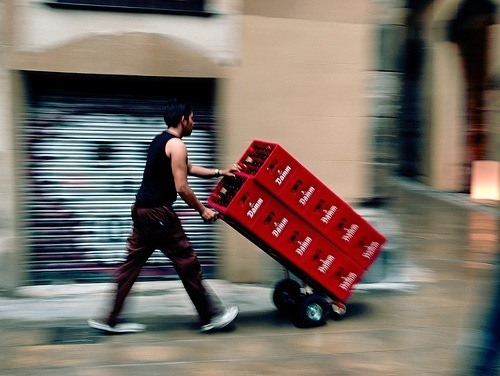
Typical mini-job
SPAIN If you haven't heard of 'mini-jobs' yet, you soon will. It is an employment concept that was established in Germany in 2003 to fight against unemployment and the 'underground economy', according to an article in El Mundo. It has also served to keep things going in the deepest darkness of the crisis. The ECB has suggested it could be applied to Spain, and the CEOE (Spain's CBI) has embraced the idea. It consists of low-wage contracts of a maximum of 15 hours per week. However, in Germany there is no minimum wage (in Spain it is called Salario Mínimo Interprofesional, set at €641.4 per month), and the typical mini-job gets paid some €400 a month - but the employee does not pay taxes and can pay in to the Social Security system on a voluntary basis. In the most-used mini-job in Germany,>>>