Showing posts with label HISTORY. Show all posts

Saturday, 3 August 2013

Why does Spain's National Anthem have no words?

Spain's National Anthem
SPAIN By definition, an anthem needs words, but Spain's is the only one in the world that doesn't. All too often, the wrong anthem is played at official functions abroad because the subject is confusing. For example, at the Davis Cup matches in Australia earlier this year, they played the Republican anthem - which was banished by Franco in 1937. More recently, the Vice-President of the Junta de Andalucía, Diego Valderas, was received in Palestine by an anthem with lyrics by José María Pemán, which was used -but never officially approved- during the Franco era (Valderas belongs to the Communist Party, a part of Izquierda Unida, or United Left, historically very much opposed to Franco in his time). It was the same music we hear today, but included the regime-approved words. This music is>>>

Wednesday, 12 June 2013

Historical connection between UK and Jimena

JIMENA Just made Facebook friends with someone who way back when (February 2010) wrote to CampoPulse (actually, JimenaPulse at the time) to ask if we could find out about her grandfather, who emigrated from Jimena to the UK. She is visiting Jimena next week, when we hope to find out more about him - and she's agreed to a short interview for CampoPulse. The image is a copy of her grandfather's entry of birth in the registry (Registro Civil) in Alberto.

Wednesday, 29 May 2013

The history of Jimena in images - a fascinating page!

JIMENA Over the weekend somebody asked us if we'd seen a 'historical' Facebook page. We hadn't, and we forgot about it until this morning, when we looked into our Spanish colleagues over at TioJimeno. And there was a story about Jimena when it was 'reconquered by the Christians (vs. the Moors) in 1431, with illustrations of it at the time. We couldn't resist it, so we went to the page (https://www.facebook.com/groups/historiajimenaimagenes/) and have made a Friend Request; we want to go more deeply into the subject. Not that it isn't fascinating just as it is: >>>

Wednesday, 13 March 2013

The Pope's Chair

Mobile phone masts invaded
the Roman ruins
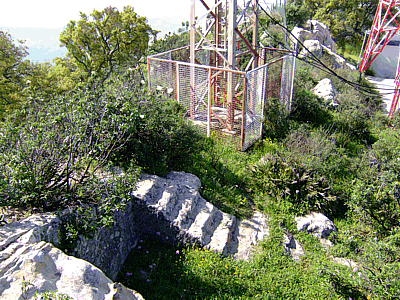
TARIFA There is a spot near Tarifa - and close to the Roman ruins at Baelo Claudia - called locally La Silla del Papa (or The Pope's Chair). Alas, these Roman ruins have never been properly excavated, and they have suffered modern day pressure with an invasion of the area by several mobile phone masts. But a recent meeting held at the Baelo Claudia centre there has set the bases for a number of projects aimed at revealing more about the Pope's Chair. This thanks to an ongoing agreement between the Council for Culture and the Casa Velázquez High Spanish Studies, based in France.>>>

Friday, 8 March 2013

Tragedy in the Straits of Gibraltar

Two fishing boats set out for Canaries and never return · British ship involved
ALGECIRAS A book presentation is taking place this evening at the Millán Picazo Auditorium in Algeciras. José Regueira, Jimena's retired pharmacist and Official Chronicler of the village (and father to the two current pharmacists, Victor and Hector) left Galicia fifty years ago, but never lost touch with his native A Coruña, and for years wrote articles for La Voz de Galicia, connecting that northwestern region with Cádiz. Much of what he wrote was about the sea, a common thread to both communities. One of his articles, a real sea story of the Spanish Civil War, caught the attention of a reader in the northern region. It was about two fishing boats, manned by 24 Galicians, that left Algeciras, in the midst of the war, headed for a port on the Saharan side of the Canary Islands. They never returned. That reader happened to be the grandson of Enrique Pereira, the skipper of the San Fausto, one of the boats. There's a lot more to this Campo de Gibraltar story that was also researched by Luis Romero and José Manuel Algarbani.>>>

Friday, 1 March 2013

Junta removes grants for conservation of Church and municipal heritage

Work in progress at Jimena castle
(Photo: buceite.com)
Culture department targets buildings used as stages, archaeology activity and acts in historical premises
ANDALUCÍA Once again it is the country's heritage and arts that suffer under the tragic cutbacks resulting from Spain's financial crisis and a consequent 'lack of credit', according to the Junta's official bulletin (BOJA). Thus, grants or subsidies requested by town halls throughout the region to maintain their heritage, carry out archaeological research (in an area that is heavy with Roman, Phoenician and Moorish remains, among others) or renovate their historic scenery have disappeared, together with help given to the Church for the same purpose. At a stroke, the department headed by Luciano Alonso (PP) has ordered the suspension (read 'elimination') of a series of activities and events that have delighted residents and tourists for years.

Friday, 22 February 2013

Sephardic Jews to be given automatic Spanish citizenship; Muslims complain

Where did they go?
MADRID Ancestors of today's Sephardic Jews were thrown out of Spain together with the Muslim Moors, by the Christian Monarchs Ferdinand and Isabella in 1492. Until recently, they have had to have been residing in Spain for two years and prove financial sufficiency to get Spanish nationality. Now they are being allowed to obtain automatic citizenship if they can produce a certificate confirming their descendancy. The move does not apply, though, to the descendants of Jews who ostensibly converted to Christianity to escape the persecution that went on for the better part of the 16th century, called Conversos. The new law says that these must convert 'back' to Judaism to qualify. There are calculated to be some 45,000 people of Sephardic origin in Spain at present. The Muslim community, however (a full article on this subject will soon be available on SpainInformer.com)

Wednesday, 15 August 2012

Today is St Mary the Crowned's Day -- so?

Jimena's St. Mary the Crowned
SAN ROQUE / JIMENA We are bad on saint's days - no, we're not good at knowing or remembering which saint is when. But we picked up an article to say that today, August 15, is Saint Mary the Crowned's Day, and celebrations were being held in San Roque at 8 tonight, with a procession of the saint, who will emerge from her church in one of the town's lovely squares, and yesterday saw the traditional offering of flowers to her image. The name rang a bell. Then we remembered that Jimena also had a church dedicated to Saint Mary the Crowned (Santa María la Coronada). But it no longer exists: the only remains are the bell tower (campanario) on the main square there, and some of the buildings to the West of it, which over the years have been incorporated into homes there. (An article on the history of the square is in preparation. Watch this space.)

Monday, 25 June 2012

Jimena castle closed off to visitors

JIMENA Further to our question about whether restoration work was about to begin, we found that the castle in Jimena has been closed off to visitors, presumably in preparation for that work. To quote friend and renown archaeologist Hamo Sassoon, in his epilogue to a book published at least fifteen years ago: "I cannot end this report without commenting that the priority in the Castle is not excavation, but rather the urgent and professional repair of the many places where the fabric of the structure is in immediate danger of collapse." (Oba Romana. Roman Jimena. Editorial Regueira.) The fact is that several places have collapsed since then, though fortunately not enough to cause major damage. It is worth noting the word 'professional'. Another point: a report by Councillor for the Treasury Pedro Corbacho, said that of the €750,000 grant the Council received last year for restoring the castle, €250,000 have yet to be found. Is this new restoration work the same project and has the missing money been found? Or are we yet again to see important work stopped half way when the money runs out?

Sunday, 24 June 2012

Gibraltar hosts Freemasonry symposium

Spanish Freemasons form triangle,
1930s (Image: PARES)
GIBRALTAR The 13th Symposium on Spanish Freemasonry is scheduled for the Caleta Hotel from October 11 to 13 this year. The founder and Honorary President of the Center for Historic Studies on Spanish Freemasonry (CEHME in its Spanish acronym), José Antonio Ferrer Benimeli, and its present President, José Miguel Delgado Idarreta, where on the Rock on Thursday to announce the event, which will be held under the title 'Gibraltar, Cadiz, America and Freemasonry; Constitutionalism and Freedom of the Press 1812-2012'.>>>

Friday, 22 June 2012

Is restoration work starting on the castle?

JIMENA This photo by El Niño de las Torres on TioJimeno's El Rincón de Contreras section announces that work is afoot on the castle, which needs it badly and urgently. Whether picks and labourers are imminent up there is another matter. According to El Niño, there are also barriers and even a guard's hut as well. You never know. As Manolo says, "The castle is very old. It'd be cheaper to knock it down and build a new one." (As quoted on TJ)

Tuesday, 19 June 2012

25 years since Hipercor bombing

Barcelona, June 19, 1987
SPAIN It is 25 years since an ETA (Basque terrorists) blew away the lives of 21 innocent shoppers in the Hipercor shopping centre in Barcelona, and injured another 45. ETA took responsibility for the powerful blast but in a subsequent communiqué announced that they had given the police plenty of warning but the place was not evacuated. This almost provoked a military rising at the time, 1987, because of what various Army commanders called 'police inefficiency'. True, too, that top officers of the Guardia Civil and the military, as well as the Military Governor of San Sebastián, had already been killed by the terrorist group, which led to a change in attitude towards ETA, who had until then clung to certain anti-dictatorship mystique. 

Monday, 18 June 2012

Old Jimena, old photos, good memories

JIMENA  Our colleagues at TioJimeno have a section called Photos for the Memories (approx.) which we sometimes bring on to this site. This is one that certainly brings back memories to Prospero, who knew or knows all of the characters in this photo. It was taken (plenty of) years ago at the old La Tasca, which was where the taxi rank is today. Here are some of the people who welcomed Prospero into Jimena over twenty years ago, including Pepe and Victoria, who friends and customers will recognise immediately.

Tuesday, 22 May 2012

Duke of Medina Sidonia offers conference tomorrow

The Duke's coat of arms
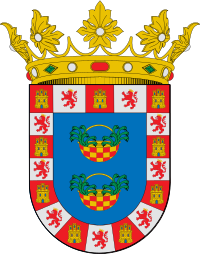
GIBRALTAR The Instituto Cervantes has scheduled for tomorrow, May 23, at 7pm, a lecture by the Duke of Medina Sidonia,  Alonso González de Gregorio y Álvarez de Toledo, under the title of 'Gibraltar, and the Duchy of Medina Sidonia in the XV Century'. The Duke is a Professor of History at the University of Castilla-La Mancha and of the School of Diplomacythat belongs to the Ministry of Foreign Affairs & Cooperation. The lecture will start with an explanation of the Spanish feudal system of that era, which is very different to that of Britain, followed by the history of the close relationship between the House of Guzmán, founded by Guzmán el Bueno, the first of a lineage that goes back to  the 13th century, and Gibraltar, which began with the foundation of the Duchy itself and ended towards the beginning of the 16th century.

Thursday, 22 March 2012

History & Archaeology Workshops coming up

JIMENA This year's History & Archaeology Workshops, the 19th edition (already!) is scheduled for the weekend of March 30 and 31, with a full programme of conferences and events, as it always is. The spirit behind this event since its inception is the Official Chronicler of Jimena, Don José Regueira Ramos, once the village pharmacist and father of the two present incumbents. He started them with others, including Hamo Sassoon, long time resident of the village, sadly absent since 2004. Read the whole programme below, untranslated; if you want to attend, you will have to have Spanish.>>>

Wednesday, 7 March 2012

JimenaPulse's very first item - originally published on March 5, 2007


Title: WALKING ALONG THE RIVER
(Picture missing, will try to find it!) Along the Hozgarganta River, on the village side, is a footpath that was probably created originally by the Romans, who carved their way into the limestone rock (see picture). Later, in the XVII Century, a foundry mill (known today as La Fábrica de Bombas, The Bomb Factory) was built at great effort and expense, near the present bridge at Pasada de Alcalá. However, due to miscalculations about water levels in the summer (there ain't none), it only functioned for eleven years and was abandoned in favour of another similar mill near today's San Pablo. See the original here. Given that this is our anniversary month, we will be putting up some of our old articles, and stats, and other bits and pieces - always supposing we have the time between trying to earn a living. WATCH THIS SPACE!


Monday, 5 March 2012

Carteia to show unseen places this weekend

SAN ROQUE An extraordinary guided tour of areas at the Roman ruins of Carteia is scheduled for this coming Saturday. Enthusiasts of Roman ruins (of whom we seem to have been meeting more lately - something in the water?) will get to see places that are not included in the usual tour, such as the theatre and what has been called 'the shops'. The tours, of 50 people maximum, take place at 10 and 11.30am, lasting about an hour and a half. Also, we're told, a visit to the top of the town gives a magnificent overall view of the 30 hectares so far unearthed. An optional addition is a visit to the Municipal Museum in San Roque. If you're interested, here's where to book and find out more: Carteia: 956 670 122 from 10am to 2pm; e-mail: cacarteia.ca.ccul@juntadeandalucia.es - or the Municipal Tourist Office, 956 694 005 from 10am to 2pm; e-mail: turismo@sanroque.es.

Thursday, 1 March 2012

Google.es celebrates 300 years of Spain's National Library

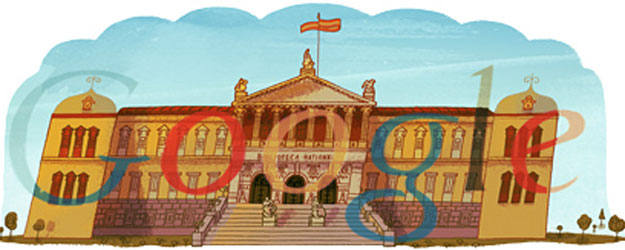
SPAIN Today's Google.es logo (a.k.a. a doodle) is a cartoon of the Biblioteca Nacional, which celebrates its 300th anniversary today, coincidentally also on International Book Day. Founded on March 1, 1712, the National Library houses 28 million documents today. King Felipe V approved of the creation of a Royal Library on December 29, 1711, on the condition that it would be open to the public. It began its life on this day in a passageway called Pasadizo de la Encarnación, now the magnificent Plaza de Oriente in Madrid, and contained numerous tomes from a large variety of places. The library moved several times over th years until it settled at its present location on Paseo de Recoletos, but was expanded with an annex in 1993 at Alcalá de Henares. These days it functions not unlike the US Library of Congress, which keeps a register of all publications, with some 861,145 pieces registered in 2010 alone. Among its most important treasures are Leonardo da Vinci's Madrid Codexes I and II, the Biblia Politica Regia (a Bible in several ancient languages  including Arameic, Greek, Hebrew and Latin), the writings of the Beato de Liébana and the Brevary  of Queen Isabel the Catholic, the manuscript of Las siete partidas, a set of laws written by King Alfonso Xthe Wise, among many others.

Monday, 26 December 2011

Fishing with 'art' in the Straits

Baelo Claudia
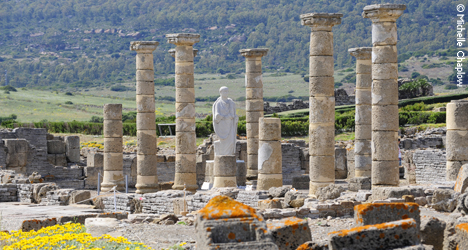
TARIFA The museum at the Baelo Claudia Roman Ruins site near Bolonia (officially, Conjunto Arqueológico de Baelo Claudia) is holding an exhibition of sea fishing equipment as used by Phoenicians and Romans, and therefore as used in Andalucía. Called 'Pescar con arte. Fenicios y romanos en el origen de los aparejos andaluces', it is on until July 31, 2012 and is described as a 'journey' that, although centered on the stretch between Bolonia and Algeciras, it also travels through the Mediterranean, from the Algarve to Sicily, via North Africa, 'in antiquity', showing the links between the different (or not-so-different) cultures and their influence upon each other. Several museums have cooperated in allowing 'priceless' objects to be shown, and there is information, too, from some 15 archaeological sites all over Andalucía. Worth seeing, we think. (note for Spanish Conversation students: the word arte means 'art', yes, but it is also applied to fishing tackle, particularly of the type used in the Straits area - fishing being an art, according to fishing people of our acquaintance.)

Monday, 21 November 2011

The Franco family millions

SPAIN (El País/Tereixa Constenla)On November 20, 1975, the Francos lost their hold on power but held on to something even more important: their wealth. Following the death of the dictator and the dismantling of the system he built, his once-sought-after relatives became social lepers. It was the worst thing that could happen to one in a country that favored social arrivistes. Struck hard by the sudden loss of privileges, some members of the Franco clan felt victimized; others faded discreetly into the background, and a few individuals took on the role of provocateurs, unable to admit to themselves that democracy was treating them infinitely better than Franco had ever treated democracy. Until the day she died, Franco's widow Carmen Polo received a pension that was higher than the salaries of the Spanish prime ministers Adolfo Suárez and Felipe González. Her only daughter and her son-in-law were able to use their diplomatic passport until it expired in 1986. King Juan Carlos I awarded them with a new title of nobility: the duchy of Franco. The tax agency never investigated their accounts.>>>