JIMENA Walking down to the office this morning, we came across two men working on the newly concreted bit of road under repair. They were mumbling about idiot drivers. Fortunately we understand Spanish mumbling: someone had driven over the fresh cement last night, having first removed the barrier at the top of the road. They had driven down onto the fresh concrete, where they stopped, creating a track mark into the concrete that will take a day or two to be set right. By the time we got back with a camera, he man in the photograph had already patched up one of the idiot's tracks, and he was complaining that whatever he did, it would always be a patch. At least he cared! We were also told that there was going to be a speed bump right there where he's working, which might just stop a few of the idiot drivers around. (Another photo below)>>>
Showing posts with label DRIVING. Show all posts
Friday, 7 June 2013
Friday, 31 May 2013
Autoescuela Jimena
Sunday, 26 May 2013
Autoescuela Jimena
Friday, 22 March 2013
Have you been fined for speeding on the A-405 road, near Castellar?
![]() |
| The area in question |
CAMPO DE GIBRALTAR We have had a number of enquiries about speeding fines on the A-405 road (the A-369 on GoogleMaps, which is about 3 years late), from Jimena to Taraguilla, particularly between the turnoff to Sotogrande International School, passing by the entrance to Castellar cemetery and the entrance to Castellar Nuevo. These fines are particularly heavy - ranging from €150 to €400 - because, we believe, that heading for the coast, there is a section with a maximum of 50kph that includes a very straight part (passing by a plant nursery), which then turns into 70kph before a sharp bend. Curiously, on the other side of that same section, heading to Jimena, the speed limit is 70 kph, which leads not only to confusion but might also be a mistake (fallen speed sign, perhaps?). If you have had a fine there, please let us know, so we can make enquiries with the powers that be... (no promises!)
Wednesday, 13 March 2013
New draft laws on speed limits, radar detectors, seat belts and children in cars
| (Illustration only) |
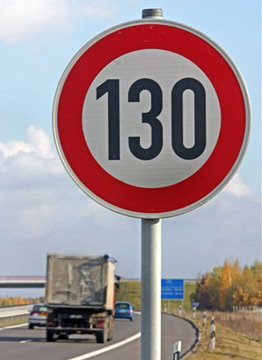
SPAIN Further to our item about the Government's plans to up the top speed limit to 130 kph, there are several changes that we didn't have time to write about. These include speed limits on secondary roads, (which are puzzlingly related to the road width - see below for details), as well as a total ban on radar detectors, new rules on seat-belt use and new restrictions on children in cars. As for radar detectors, the last government (PSOE) banned the use of radar inhibitors, appliances that interfered with radar signals from speed detectors so that the traps couldn't capture speeding vehicles. But the door was left open for car-mounted radar detectors that warn drivers of a nearby speed traps. That door is now closed.>>>
Friday, 8 March 2013
Tráfico to allow 130kph on motorways but limit to 50kph on some secondary roads
Radar detectors to be forbidden · Taxi drivers to use belts and all kids in back seat · And more
MADRID The traffic authorities (DGT, Dirección General de Tráfico) has thoroughly revised some of its regulations, according to a draft bill presented earlier this week. These include raising speed limits from 120 kph to 130 on some sections of motorways and toll roads, as well as lowering limits in some city areas and secondary roads. Limits on conventional roads such as dual carriageways and other secondary roads will be reduced variously to 90kph, 70kph or even 50, depending on the width of the road. (A more detailed article will soon be available on SpainInformer.com - but we will be expanding this one on Wednesday, so WATCH THIS SPACE!)
Tuesday, 22 January 2013
Expat drivers must now undergo medical examination
SPAIN EU Directive 2012/126 came into effect on January 19. It means that expat drivers in Spain under 65 will have to take a medical examination every ten years; for those over 65, the medical is every five years. The examination consists of computer-based sight, hearing and coordination driving simulation tests. (UK license holders must report their residence in Spain to the DVLA and still be able to declare their UK address as their permanent residence. This is defined by the directive as the place a person lives for at least 185 days in a year.) (A more detailed article on this subject will soon be available on SpainInformer.com)
Wednesday, 7 November 2012
Police to multiply driving test questions by 20
| Taking the test |
Objective: to make future drivers think rather than memorise
MADRID For years most people taking the theoretical driving test ('teórica') memorised the answers to around 800 questions. Those days are numbered: the head of the National Confederation of Driving Schools, José Miguel Báez, announced last week that the Guardia Civil's Traffic Unit ('Tráfico', or DGT) had multiplied the number of questions by 20, to 15,500 that will be set randomly. This is already being applied at several provincial test centres and would probably be completed nationwide by the end of this month.>>>
Monday, 10 October 2011
New driving tests being studied in Spain
SPAIN The Dirección General de Tráfico (DGT, traffic authority that issues driving licences) is trying out a pilot scheme in seven Spanish cities for a new examen práctico ('practical' test, as opposed to the teórico, or 'theoretical') that lasts a minimum of 25 minutes, the first ten of which will be without instructions from the examiner. The objective of a new test would be to 'meet European standards better' and to 'offer better quality', according to Pere Navarro, head of the DGT. European directives have given until 2013 to upgrade driving tests throughout the EU and the seven cities where the new test is being piloted are Burgos, Segovia, Gran Canaria, Sevilla, Pamplona, Madrid and Barcelona.
Tuesday, 19 April 2011
Gibraltar driver arrested for dangerous and drunk driving
LA LÍNEA (Agencies) An 18 year old driver from Gibraltar was arrested after a chase in the Zabal industrial estate (photo, illustration only) this weekend. The Gib-registered vehicle had been followed by another car, with which it is alleged it had had an accident but had run from the scene. The young man drove onto a dirt track to hide from the police but was traced, whereupon it was evident that the driver was intoxicated. He and his vehicle were placed under arrest and temporary confiscation, respectively.
Local Police carry out special service against mobile phone use while driving
LOS BARRIOS (Agencies/Photo: illustration only) A special campaign against distractions while driving was carried out by the local Police from April 4 to 11, with controls on 454 vehicles. Eleven drivers were reported for using a mobile phone while driving, and another for another infraction. Distraction caused 608 accidents last year on Spanish roads, and a total of 684 deaths as a result. Using a phone while driving multiplies by four the risk of an accident. There are no statistics on the application of make-up.
Monday, 7 March 2011
Speeding over 110 kph can be fined with €100
SPAIN (Agencies) If you drive over 110 kph but under 141, you can be fined €100. Over that, up to 151, the fine is larger, though no points are taken off your license. But over 151 kph, the fine is €300 or more, and you lose two points off your license.
Sunday, 6 March 2011
Remember: top speed is 110
SPAIN (Agencies/Photo: EuropaSur) As we (and the Government) announced last week, the top speed in Spain will be 110 kilometres per hour as from midnight tonight, i.e. from Monday, March 7. The measure, it was announced on Friday, is temporary and is planned to last four months, depending on the energy situation. The objective is to save energy as Spain imports over 75% of its oil - that, plus chaos in Northern Africa. All signs on major roads should have been changed by now, and although there is no news about the radars, is it worth risking a hefty fine? An interesting study about the cost of the signs is in this morning's EuropaSur, which we have translated and summarised below:>
Friday, 25 February 2011
Top speed goes down to 110 'to save energy'
SPAIN (Agencies/Photo montage by EuropaSur) The Government announced this morning that it had decided to lower the top speed on autovías and autopistas (highways) from 120 Kph to 110, starting on March 7. According to Vice-President Alfredo Pérez Rubalcaba, this is a "temporary measure" and part of more plans aimed at saving energy, and is "closely related" to the rise in oil and petrol prices resulting from the situation in North Africa. Aside from this speed reduction, another two measures are being put in place:>
Thursday, 24 February 2011
Campo needs a Learner Drivers' track
CAMPO DE GIBRALTAR (Agencies/Photo: illustration only) The PP mayoral candidate for Algeciras and national deputy, José Ignacio Landaluce, asked recently for solutions to Campo residents' problems when wanting to take advanced driving tests (types AM, A1, A2, A, C1, C1+E, C+E, D, D1 and D+E). These tests cannot be carried out on public roads and need enclosed, specialized testing and/or training facilities, which are unavailable in the area. This forces those taking these tests to travel to the nearest facilities in San Fernando or Jerez. "A city such as Algeciras has not had these facilities since 2008, and all we need are some 10,000m2. Local drivng schools have all agreed to cooperate on the matter," said Landaluce.
Wednesday, 16 February 2011
Arrested for driving at 230 kph on A-7 motorway
ALGECIRAS (Agencies/Photo: illustration only) the Guardia Civil arrested a 25 year old man from La Línea for driving at 230 kilometres per hour on the A-7 motorway. He was clocked at 3am on Sunday morning as he drove his Renault Clio along the by-pass, according to a note from the GC. The car was stopped some way along the road and the driver given a breath test, which showed he was not above the alcohol limit. He is charged with driving recklesly, above the speed limit, which at that point is 100 kph.
Thursday, 3 February 2011
One in four Spanish drivers can't see properly
SPAIN (Agencies) A study by the Universidad Politécnica de Cataluña (UPC), with the cooperation of the RACC (Spain's AA) and the Visión y Vida Association ('Vision and Life') concludes that one in four drivers in Spain - about six million - has at least one problem that seriously affects their sight and therefore their driving. The study, carried out on 1,000 drivers between May and September last year, looked at six visual factors as related to driving ability: visual acuity, binocular field of vision, dazzlement, chromatic perception and three-dimensional vision (stereopsis), according to Aurora Torrents, the UPC professor in charge of the research.>
Wednesday, 15 December 2010
Hits six cars, registers five times legal alcohol limit
ALGECIRAS (Agencies) Shortly after 10pm on Monday night, Local Police agents attended an accident on Avenida Ramón Puyol. A driver had hit six cars parked in the road. It turned out to be a 26 year old man, of Algeciras, who was slightly injured and was taken to hospital, where a blood test revealed that he had 2.5 grammes per litre, five times the legal limit and twice the amount for it to be considered a crime. He is 'at the disposal of the courts'. The police continue their breathalyser campaign throughout the week, a practice in all the area's municipalities at this time of year. (Image from an anti-drunk driving campaign on classicruby.blog.com)
Friday, 10 December 2010
Drunk driver travels 14 kms along A-7 on the wrong side
ALGECIRAS / SAN ROQUE The Guardia Civil managed to stop a driver on the A-7 road because they had been alerted that a vehicle was travelling on the worng side of the road. The man, who showed three times the amount of permitted alcohol in blood, had started out in Algeciras and was finally stopped at San Roque. One driver had an accident when trying to avoid him. The incident occurred in the small hours of Friday morning and the man, whose initials have not been divulged, is now 'at the disposal of the courts'.
Friday, 22 October 2010
How do you go round a roundabout in Spain?
SPAIN In an eternal quest to avoid what is shown in the photo, this subject comes up often in conversation, usually after someone has had a close call with another car on a roundabout, or has been fined for being in the wrong lane. We have endeavoured to find out what the law actually is, and there is a wealth of comments, forums and such on Internet, but we have been unable to find any coherence among them all. Below you will find an image that gives a decent idea of how you're supposed to drive around a roundabout. It is not true that there are no laws, it's just that these are meant for someone else.>
Subscribe to:
Posts (Atom)