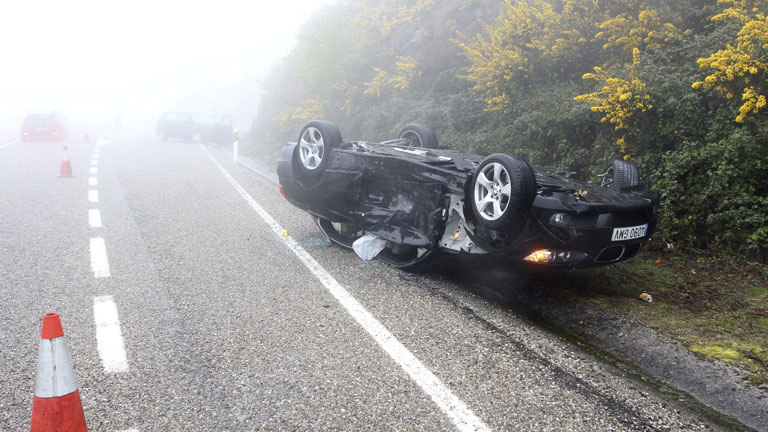
SPAIN A report by the Royal Automobile Club of Catalonia (RACC in its Spanish acronym) says that the Ministry of Development's budget for road maintenance has been reduced by 38% since 2009. The same report says that if the investment were doubled, the social cost of accidents would drop by 20%. The maths are simple: present investment is €31,662 per kilometre, almost half of that social cost, which averages €64,182/km. The RACC has published a roadmap of the social costs that applies cost-benefit formulae, which is applied for similar studies in Germany, among other countries. Social costs are>>>
Showing posts with label ROADS. Show all posts
Monday, 10 June 2013
Saturday, 20 April 2013
No more Big Dipper, no more Hole in the Road!
JIMENA As we were watching the goings-on at the benefit do for Carmen Infantes last night (photos and commentary coming up), we got the word from Mayor Guillermo Ruiz that the entrance to Jimena was now open. Considering that we haven't seen anyone working on it, we're quite prepared to believe in miracles. Just in case you don't believe us, below are some more photos of the facts.
Wednesday, 3 April 2013
Jimena entrance road to get emergency repairs
![]() |
| (Photo: europasur.es) |
JIMENA Anyone driving up the hill into the main village will have noticed a dip in the road that seems to get worse every day. The Council announced this morning that emergency repairs will be getting under way very soon and the road is likely to be closed while work is being done. In the meantime, there is now a weight restriction of 5 tons on that section of road. Entrance to the village is now by the 'middle road' or by the campsite. Regular line buses and school buses can no longer use this stretch, which is only about 50 metres from the A-405 crossroad, so passengers and students have to disembark at the bottom of the road, right by the old silo and the new Local Police station. The cause:>>>
Tuesday, 2 April 2013
Jimena - Puerto Galis road gets emergency repair funds
| Provincial Infrastructure head Eduardo Párraga and Jimena Mayor Guillermo Ruiz |
JIMENA The CA-8201 road between Jimena and Puerto Galis is to get repaired thanks to some €83.600 from the provincial authorities, which is part of emergency funds of €229,500 being made available for a total of three roads that have suffered extensive damage with the recent heavy rain storms. There are some seven secondary roads in the province that remain closed after the storms, and Diputación (the provincial authority) has calculated that damage to roads in the province so far amounts to four million euros.
Friday, 22 March 2013
Have you been fined for speeding on the A-405 road, near Castellar?
![]() |
| The area in question |
CAMPO DE GIBRALTAR We have had a number of enquiries about speeding fines on the A-405 road (the A-369 on GoogleMaps, which is about 3 years late), from Jimena to Taraguilla, particularly between the turnoff to Sotogrande International School, passing by the entrance to Castellar cemetery and the entrance to Castellar Nuevo. These fines are particularly heavy - ranging from €150 to €400 - because, we believe, that heading for the coast, there is a section with a maximum of 50kph that includes a very straight part (passing by a plant nursery), which then turns into 70kph before a sharp bend. Curiously, on the other side of that same section, heading to Jimena, the speed limit is 70 kph, which leads not only to confusion but might also be a mistake (fallen speed sign, perhaps?). If you have had a fine there, please let us know, so we can make enquiries with the powers that be... (no promises!)
Tuesday, 12 March 2013
Landslides on CA-8201 (Jimena - Puerto Gális) close road
JIMENA / Puerto Gális The 'back' road from Jimena, the CA-8201, to Puerto Gális (and on to Ubrique or the coast) was closed yesterday because two separate landslides had eaten it away as a result of the weather - yet again. This is not the first time this road has been closed for the same reason: it remained closed for several weeks in the winter of 2010. The need for proper repairs, and even a new road, is evident. (See more photos on TioJimeno.)
Friday, 26 October 2012
Mayors of all parties get together about A-377 road
GAUCÍN The mayors of ten municipalities and a variety of political colours got together this morning in Gaucín to decide on what next to do about the A-377 road between Gaucín and Manilva (as we reported here). The remaining ten mayors of the twenty expected, most of whom had already signed the agreement at the previous meeting, offered their apologies for not being able to assist. Thus, the mayors of Casares, Gaucín Algatocín, Benarrabá, Cortes la Frontera, Jimera de Libar, Benadalid, Genaguacil, Jubrique and Pujerra, created a COMING SOON:
Mayors meet in Gaucín about A-377 road to Manilva
![]() |
| Click to enlarge |
GAUCÍN A formal group of Mayors of councils that run along the A-377 road between Gaucín and the A-7 coastal road at Manilva are at this moment meeting in Gaucín, to which all 20 councils on the Serranía de Ronda impacted by the road have been invited, to ratify an agreement they came to last February, and which most have already signed. This is essentially a complaint to the Junta road authority about the state of the road, which, they say, has had and is having a devastating effect on the tourism business on which they rely. This meeting will also be to elect the representatives who will now elevate their complaints further afield than the province of Málaga, and to the Junta's offices in Seville. (More on the subject when the meeting ends.)
Thursday, 16 August 2012
Jimena and San Pablo roads to be improved
Forty kilometers of roads to undergo works - but when?
JIMENA (Press release) The provincial road authorities announced on Monday that tenders are being invited for improvements to roads on the northern part of the Campo de Gibraltar. More specifically, these are the CA-8201 that runs from Jimena to Puerto Galis (known as the Ubrique road), a stretch of 18kms, and the CA-8200, which goes from San Pablo de Buceite to San Martín del Tesorillo, some 22kms. How these are to be financed is not made clear in the press release we saw, but if the present economic climate is anything to go by, we wonder when exactly work might be scheduled to begin - and end. These roads have been under the magnifying glass of various ministries and local government entities for a number of years, so please allow us, and you, a pinch of salt.
Labels:
JIMENA,
ROADS,
ROADWORKS,
SAN MARTÍN DEL TESORILLO,
SAN PABLO DE BUCEITE
Tuesday, 14 August 2012
Ministry plans total ban of alcohol at the wheel
Speed limits on secondary roads to be lowered
SPAIN (Agencies) Minister of the Interior Jorge Fernández Díaz announced earlier this week that he is preparing a series of restrictions and regulations. Among these is a complete ban on alcohol in the blood when driving. While he pointed out that these were in the preparation stage and not yet law, the minister added that other measures include a speed limit reduction on secondary, or N-roads, would deal with the roads that show three quarter of all fatal accidents. To compensate for this, speed limits on motorways will be increased "where safety is not compromised." Fernández Díaz did not say by how much. Other moves include making bicycle helmets obligatory on all roads, including inner city streets, beginning with under-18s. A ban on cycling on the pavement is also on the cards. The minister said that although the number of fatal accidents had decreased considerably "there is always room for improvement."
Labels:
DRINK DRIVING,
LIFE IN SPAIN,
ROADS,
SPEED LIMITS,
TRAFFIC
Tuesday, 19 June 2012
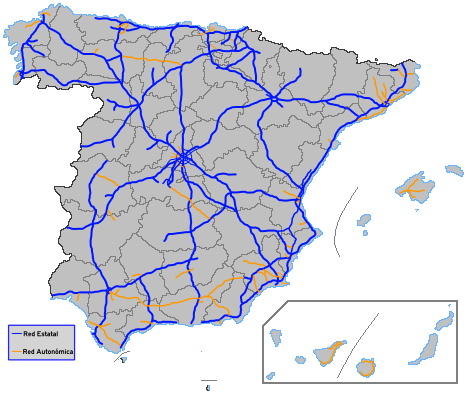
Variable speed system for main roads planned
| Main road network in Spain |
Labels:
LAW,
LIFE IN SPAIN,
ROADS,
SPAIN,
SPEED LIMITS,
TRAFFIC
Thursday, 3 May 2012
This is NOT a speed trap
![]() |
| (Photo: europasur.es) |
ANDALUCÍA The DGT (Dirección General de Tráfico) is installing a new computerised management system on the A-381 Jerez-Los Barrios road. The system began installing it about a year ago with the first electronic traffic information panels at the Campo de Gibraltar end of the road, which are still not in service. Motorised video cameras have also been installed, as have the cables that allow information to be delivered along 87 kilometers of road. The project is still incomplete and no date for it to become operational has been announced. Nevertheless, just a few weeks ago some new equipment - coloured blue and similar to halogen lamps - were installed on the back of the panels. These became a trending topic on the social media, which say they could be radar controls. In a statement to Europa Sur, the DGT denied that they were speed traps. However, they are, apparently, cameras that can read number plates and are needed to measure data such as Daily Average Intensity (i.e. road usage) but do not contain the necessary video recorders that would be used to emit speeding fines. The panels will - when the system is finally operational - give such information as traffic density, diversions, weather warnings and delays, among other things. The number plate readers will establish how long it takes to cover a given distance and therefore be able to announce the approximate time remaining to get to a specific spot. The DGT insisted that this is not a speed trap, but there are two of these at Kms 37.3 and 74.7 on that road.
Tuesday, 3 January 2012
A-7 toll road ups prices
COSTA DEL SOL New year, new prices. The toll road from Guadiaro to Málaga (called autopista) went up to a low season's total price of €8.55 - and to €13.95 in summer. The prices were approved by the Ministry for Industry on December 19. Thus, the price rise is in the order of 3.6% for each of the three sections during 'regular' periods, which is more than the CPI (Consumer Price Index) rose all of last year. The new prices per section: barriers at Estepona, €1.85 low season, €3,05 in summer; at Marbella €2.70 / 4.40; and at Málaga €4.00 / €6.50. (...and a Happy New Year...)
Wednesday, 14 December 2011
Chaos at new access to the Algarve
| (Photo: diariodecadiz.es) |
PORTUGAL / Algarve The new toll road that accesses the Algarve after crossing the border into Portugal on the Guadian River is in chaos. The reason is that the international bridge requires payment of a toll as from last weekend - but there is very little clarity about how to pay it, with a confusion of methods and prices: foreign registered cars get options ranging from short stay, rental of special card for longer stays and the Via Verde for permanent stays. But the machine that issues the tickets had broken down, just to complicate matters. The A-22 toll bridge has been very controversial since it was first planned but protests from the Portuguese tourism industry, various workers' and farmers' organizations and regular citizens have been widely ignored. The first to suffer under the new tolls are the small restaurants and businesses in Monte Gordo, Altura, Tavila and others nearby, where Spanish tourists from Huelva used to flock for their Sunday family lunches. The tiny information office was overwhelmed by people, mainly Spanish, asking how to get to where they were going.
Thursday, 1 December 2011
Tolls on major and minor roads?
![]() |
| Long and winding road |
SPAIN The Under-Director General of the DGT (Dirección General de Tráfico), Federico Fernández, recently presented the idea that charges should be made on all roads, major and minor. The thought behi9nd it is that he believes that 'not much infrastructure will be built in the near future', which is probably correct, given the present economic climate. Fernández added, "Building, maintaining and exploiting the roads is not free of cost. The decision the politicians have to make is whether everyone pays for the roads, or only those who use them." Asked if his proposal was the beginning of road privatization, he said, "That could be the way forward." He said that many European countries have an extensive network of toll roads, and there is no reason why Spain should not. In fact, many of the country's roads are financed by tolls, which "guarantee good maintenance," he added. "Tolls, after all, are not only about financing the roads, but also about controlling traffic mobility."
Saturday, 5 November 2011
You can throw a dog down a cliff in five minutes now ...
JAÉN (Source: cheekybooger.es) ... but you may not want to. Unless you knew what we're bashing on about. The name is interesting: despeñadero means cliff or gorge, and perro means dog (you knew that didn't you?), so Despeñaperros is literally 'a place where dogs plunge over cliffs' - or where this activity used to go on in remote times (no comments, please, just think of dwarf tossing of recent note Down Under). In fact, the name is that of a gorge or canyon carved out by the Despeñaperros River. It is located in the municipality of Santa Elena in the northern portion of the province of Jaén. It is a 76.49-square-kilometre area that was declared a natural park by the Junta de Andalucía, primarily for its geology and landscape, but also for its notable flora and fauna. It has traditionally been the dividing line between Andalucía and the rest of Spain.>>>
Thursday, 8 September 2011
Proposal to set speed limit to 90 kph on single-lane highways
SPAIN (Agencies) The head of the DGT (Dirección General de Tráfico, or highways agency), Pere Navarro recently proposed a maximum speed limit of 90 km/h on all regular, single-lane highways, regardless of the width of the shoulder. This type of road is where 75% of the country's fatal traffic accidents take place - of the 1,730 road deaths in 2010, 1,331 occurred on this type of road. Navarro also defended the move on the grounds that it would make the rule simpler for drivers - at present the speed limit on regular highways is either 100km/h or 90km/h if the shoulder is narrower than 1.5 meters, almost impossible to measure from the driver's seat - as well as bringing it into line with the rest of Europe. The DGT hopes to get the measure through before the end of the current legislature. If accepted, it would be passed into law in a similar way to the temporary speed-limit reduction from 120km/h to 110km/h on multi-lane highways, which came into force in March via a reform to Spain's traffic regulations, and was rescinded on July 1.
Friday, 2 September 2011
Spectacular accident at San Roque-Gibraltar junction
![]() |
| (From video by Marco Rincón) |
SAN ROQUE (Agencies) At about 3.30 this afternoon a Toyota Avensis hit a Nissan Almera as the former was trying to join the traffic heading towards Algeciras at the junction with the A-7 known as El Toril (there's a large Chinese emporium nearby), which many of our readers use every day on their way to and from Gibraltar. The Toyota crashed through the barrier over the A-7 and dropped 7 or 8 metres onto that major carriageway. There were at least two injured, who were taken by ambulance to La Linea Hospital.
CAUTION: Slippery when wet
![]() |
| (Photo: Philip Heinzl) Yesterday |
Woman dies in N-340 accident, more crashes on wet roads
![]() |
| (Photo: Europa Sur) |
TARIFA (Agencies) An Italian woman, 58, died in an accident that happened yesterday on the N-340 near the Tarifa viaduct. Her son, who was driving, is in the ICU at the Punta de Europa Hospital and her husband, the third passenger, remains unhurt. The passengers in the other car were unhurt. The accident happened at about 6.30pm when the Renault Clio the family was in, slid across the road at Kilometre 87 and slammed into an oncoming Mitsubishi Montero. This stretch of the N-340 is a notorious black spot and this was not the only accident on the same day: at 8.20pm a dark grey Alfa Romeo and a Mercedes van brushed together and stopped, blocking the road. The area's roads have registered several accidents principally by driving too fast on newly wet roads, but none as serious as this, though.
Subscribe to:
Posts (Atom)