SPAIN Vodafone, the British telecommunications company, leads the number of consumer complaints for its Spanish branch. It is also at the bottom of the 'like' list, both according to FACUA, the leading consumer organization, which has received the largest number of complaints about this company. In fact, complaints against all telecommunications companies, head the list as set out annually by the FACUA - for the tenth year in succession, even after complaints about banking, which are considerable in number. 28% of complaints about telecommunications (including mobile phone and broadband services, also billing) are about Vodafone, followed by Movistar (25%), France Telecom (25%), Ono (by cable, 10%) and Jazztel (8%). Most complaints are about>>>
Showing posts with label CONSUMERS. Show all posts
Friday, 26 July 2013
Tuesday, 2 July 2013
Defining 'cláusula suelo' - what to do about it and getting your money back
![]() |
| Reading the small print |
SPAIN The two words have been much in the media recently, not least because the clauses in a mortgage contract have largely been qualified as abusive banking practice by the Supreme Court. Cláusula, of course, means clause; suelo means floor - floor rate clauses, in other words. There is also something called cláusula techo, which means a roof clause, though better understood as ceiling. That's the top and bottom of the definition. But what do they mean, and are there similar clauses in mortgage contracts in other countries? It is sometimes known in English-speaking countries as the base rate clause, but that could be confusing as the translation is used for other unrelated things too. Another possible translation is 'minimum interest rate' - you get the idea. Let's make it simple: When a mortgage contract is signed, a series of conditions are established that will last until the end of the contract - which is of course why we are always told to read the small print, so as to avoid later surprises.>>>
Tuesday, 26 March 2013
Olive oil may not be what it says it is
MADRID A consumer organization, Organización de Consumidores y Usuarios (OCU), reported recently that it had carried out tests on 34 brands of Extra Virgin Olive Oil and 6 on Virgin Oil brands aimed at checking their quality. A battery of chemical tests that followed the official analyses system revealed that most of the leading brands meet all current regulations, but 9 do not. In these latter cases, the oil is labeled 'extra' when they are simply 'virgin'. This, says OCU, is fraudulent because not only is it mislabelling but also sells a lower quality of oil at prices for a better one. It is not, however, a matter of food safety, but of illicit financial gain. The price of a litre of Virgin Olive Oil is around the €2,50, while the Extra costs around one euro more (see listing below).>>>
Saturday, 23 February 2013
What is a Complaints Form and how do you use it?
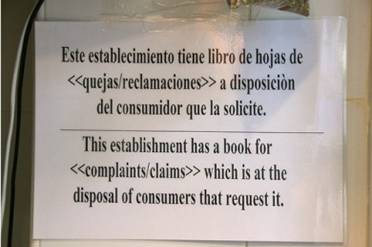
SPAIN / ANDALUCÍA You will have seen the printed sign almost everywhere: ‘This establishment has a Complaints Form which is at the disposal ...‘ But what's it for? It is are an instrument whereby consumers can complain about businesses or services. They inform the relevant consumer protection authorities about an incident or complaint so that the matter can be dealt with. Should the complaint be warranted, the shop or other business will be sanctioned. The forms, which must by law be available to the consumer at all times and may vary in size, shape and so on but not in content, have three essential objectives:>>>
Friday, 19 October 2012
Ups and downs for consumers
Remember this from just a few days ago? We said that this packet of cream crackers cost €1 one day, and a week later, it had gone up to €1.30 - when VAT went up by only 3%. We sent the item to TioJimeno, who published it on October 12. Surprise, surprise, a week after that, the item had gone down to €1.19 - which is still well above the VAT increase. Is this the power of the media? Or are we consumers getting fed up with the abuse? Do you have any other outrageous price rises? Send them in.
Thursday, 13 September 2012
Ombuds(wo)man demands clarity on electricity bills
| Soledad Becerril (Photo: absolutsevilla.com) |
Comparative shopping to be encouraged
MADRID The national Ombudsman, Soledad Beceril, has opened an investigation into the Ministry of Industry, Energy and Tourism to find out what is being done about making our electricity bills easier to understand. The ministry has already requested reports from the National Competence and National Energy Commissions. Nevertheless, in a press release Becerril saysSOON YOU WON'T BE SEEING THE REST OF ITEMS LIKE THESE WITHOUT SUBSCRIBING.>>>
Friday, 30 December 2011
Prices have risen by 48% since the euro, salaries by only 14%
![]() |
| Huevos, up by 114% since euro |
SPAIN The only things that have come down in price since the arrival of the euro ten years ago on January 1, 2001, are related to technology. According to OCU (Organización de Consumidores y Usuarios), the consumers organization, bread, a basic necessity in the country's shopping basket, rose by a whacking 81% since then. The officical shopping basket used as a measuring stick for these things, went up from costing an annual average of €4,600 to its present €6,800, an increase of 48%. The average salary, though, went up by a mere 14% in comparison. Some other items: eggs, up by 114%, milk, 48%; rice, 48% and olive oil, 33%. These among a lot of other items. OCU says that this is the moment to 'do some maths' as 'neither the euro nor the EU are going through their best moments' and there is an abundance of rumours about returning to pesetas, marks, francs or whatever. Other comparative prices rises include>>>
Sunday, 10 July 2011
Lashing out online: a consumer revolution
SPAIN (El Pais/Ana Lorite) Fame is short-lived, but what gets posted online lasts forever. Companies clearly do not want hundreds of protests about their service circulating around cyberspace, and their online reputation is a reflection of a brand's prestige. Consumers supply the content - easily and cheaply - and companies can't control it because it gets distributed en masse and can even create unwanted publicity.
Some firms have filed lawsuits against the forums that publish these complaints, but the Supreme Court has so far ruled in favor of the websites' right to publish. Other companies have learned their lesson, and have tried to embrace the phenomenon, encouraging, for example, communication between users on their own sites. The success of online complaints is joined by a social factor: Spaniards are no longer embarrassed to denounce abuses by companies and public offices.>>>
Tuesday, 15 March 2011
Today is World Consumer Day
SPAIN (Agencies) As we know by now, Spain is very keen on 'World' and 'International' days, with which the annual calendar is brimming. That may be why, on the eve of the 30th anniversary of World Consumer Day, the Minister for Health, Social Policy and Equality, Leire Pajín, announced yesterday that her ministry iod preparing a white paper aimed at improving the lot of Spain's consumers. The future law, says Pajín, will "guarantee a minimum of quality" from Customer Service departments, which take up many of the complaints among consumers. The agreement she signed with the Public Prosecutor, Candido Conde-Pumpido, has as its main objectives to prevent and combat fraud. The Instituto Nacional de Consumo (National Consumer Institute) will be in charge of executing the agreement, which is for one year but extendable. (Links of interest: Organización de Consumidores y Usuarios (OCU); FACUA-Consumers in Action; Federación de Usuarios y Consumidores Independientes (FUCI); Confederación de Consumidores y Usuarios (CECU))
Tuesday, 8 March 2011
Cádiz Consumers Union asks for more vigilance over underage drinking
CÁDIZ (Press release) With the Carnival season very much upon us, the Cádiz Consumers Union (Unión de Consumidores de Cádiz) has launched a campaign aimed at better control over the sale of alcohol to minors. It is, says the campaign, up to local administrations (i.e. police and security forces) to improve their methods. The sale of alcohol to anyone under the age of 18, but there appears to be nothing to stop someone over that age purchasing drinks for under age mates. In many if not all places, however, it is also forbidden to drink alcohol in the street other than at specified places - but this is rarely enforced. The Consumers Union asks that the laws be enforced and if they are broken, they be denounced immediately.
Thursday, 24 February 2011
Unsafe Carnival costumes warnings
SPAIN (Agencies) With Carnival fast approaching, the Spanish Consumers Union (OCU) has tested numerous costumes and accessories purchased at various outlets throughout the country. Nine out of ten of the items (10 full children's costumes, 5 for adults, 4 children's masks, 4 wigs for adults and 6 different make-up kits) showed safety problems and dangers. OCU confirms that the price of an item is no guarantee of safety and calles the presence of lead in children's costumes as 'intolerable', as is the use of a plastic additive called phthalates that gives plastic more flexibility but is highly toxic. Until the authorities carry out the appropriate controls, the organization advises consumers to take following precautions:>
Labels:
CARNIVAL,
CONSUMERS,
LIFE IN SPAIN,
SPAIN,
WARNINGS
Saturday, 5 February 2011
'Airlines are not allowed to charge for printing boarding passes'
SPAIN/Andalucía (Agencies/Image: illustration only, from www.terminalu.com) The Junta de Andalucía's Health Council (Consejería de Salud, also in charge of consumer affairs, in case you wondered) has issued a warning to remind passengers that, by law, airlines must issue a ticket free of charge. They can therefore not charge for printing up a boarding pass when a passage has been bought online. Some airlines have been charging up to €40, says the Council. The only document that is legally valid for passenger access to an aircraft is a boarding pass. The matter arises because there has been a considerable increase in the number of cases reported about airlines that emit a boarding pass or ticket online and then "convert what should be an option for passengers, into an obligation," says the press release. The note also reminds consumers that "not only can the airline not charge for a boarding pass, but nor can they deny acces to the aircraft if they refuse to issue the pass without charge;" this is a serious matter that could bring fines on the company ranging from €5.001 to €30.000.>
Saturday, 29 January 2011
Mobiles, broadband, landlines, subject of most consumer complaints
CAMPO DE GIBRALTAR The statistical balance of consultations and complaints registered by the consumers organization FACUA's Cadiz office during 2010 for the Campo de Gibraltar comes up with 559 consultations and 188 complaints from consumers of the area. Most cases came in about telecommunications (24.75%), power supply (9.01%), insurance (8.34%), as well as banking services. The organization points out that telecommunications (mobiles, landlines, broad band, etc.) is yet again the sector receiving most complaints, particularly about the difficulties presented by the vaious companies when one wants to cancel services. The FACUA website has an English language facility but it is not too regularly updated, and we have never registered a complaint in English there, either. In any case, it might be a useful address to have: www.facua.org. (FACUA is the acronym for Federación de Asociaciones de Consumidores y Usuarios de Andalucía, and is vehemently active on all manner of consumerism fronts.)
Labels:
BROADBAND,
CELL PHONES,
CONSUMERS,
FACUA,
LANDLINES,
MOBILE PHONES,
TELECOMMUNICATIONS
Thursday, 10 June 2010
Electricity and VAT on the rise...
SPAIN
The government regulatory authorities, i.e. the Industry Ministry, are planning a rise of an average 4% in electricity bills for later this year. This coincides with a rise of 2% (from 16% to 18%) in the Impuesto de Valor Añadido (IVA, the equivalent to VAT) set for July 1. At the bottom end of the scale of electricity rises are small and medium companies (pymes, including the self-employed, about 5% rise) with households at the top (approximately 10%). While the rises are in the planning and pre-approval stages, consumer organizations are already saying that the price of electricity has risen by 26.1% in 30 months, which is six times the rise of the cost of living index (IPC in its Spanish acronym).>
Subscribe to:
Posts (Atom)